 RankStreet

Agencies are notoriously bad at doing for themselves what they do for clients. The cobbler's children have no shoes, and the agency website is usually the last thing anyone on the team has time to audit. We decided to treat digistreetmedia.com exactly like a client project: run a full audit, prioritise ruthlessly, ship, and re-audit. This SEO audit case study is the write-up of that process, including the parts that are still unfinished.
A quick note on scope before we begin. Every number in this post comes either from our RankStreet audits or from the rank tracker inside the RankStreet project for our domain. We have deliberately not included traffic or revenue figures, because a case study is only useful if you can trust the numbers in it, and we would rather publish fewer numbers than soft ones.
The SEO audit case study baseline: a 55/100 agency site
Our first full RankStreet audit scored digistreetmedia.com at 55/100. That sits in the "needs work" band: the site was not broken, it ranked for brand searches and a handful of commercial terms, but it was clearly leaving visibility on the table. The section breakdown told a more useful story than the headline number.
| Section | First audit | What the audit flagged |
|---|---|---|
| Content | 71/100 | Targeted keyword missing from the H1 on key pages |
| Technical | 74/100 | No FAQPage structured data anywhere on the site |
| Performance | 46/100 | Heavy hero image, no lazy-loading, homepage LCP above 5 seconds |
| Mobile | 60/100 | Usable, but tap targets close to the minimum size |
If you have run audits for a living, this profile will look familiar. Technical fundamentals mostly in place, content that reads well but is not explicit about what each page is for, and a performance problem caused by one or two heavy assets. It is the most common profile we see on service-business websites in India, which is exactly why it made a good test case.
The five fixes we shipped
We did not try to fix everything the audit surfaced. We took the action plan, sorted it by impact, and shipped five changes. Each one is described below with what we changed and what the audit recorded afterwards.
1. FAQPage schema on the homepage and six service pages
We wrote four to eight genuine questions for the homepage and each of six service pages, using the questions our sales team actually hears on calls: what does a retainer include, how long before SEO shows results, do you work with companies outside Delhi, and so on. Each FAQ is visible on the page and mirrored in FAQPage JSON-LD. The audit's AEO friendliness score moved from 42 to 78 after this change, the single biggest section-level jump in the project.
The template we used is in our FAQ schema markup guide. One honest caveat: Google now shows FAQ rich results only for a narrow set of authoritative government and health sites, so we did this for machine readability and AI answer engines, not for SERP stars.
2. Compressed the homepage hero image
The homepage hero was a 1.4 MB PNG. We replaced it with a roughly 180 KB WebP and added explicit width and height attributes so the browser could reserve space before the image loaded. The audit recorded homepage LCP dropping from 5.6s to 2.8s and the mobile performance score moving from 46 to 68.
That is still not under Google's 2.5 second "good" threshold for LCP, which is why performance remains on our open list further down.
3. Made the targeted keyword explicit in the H1
This one is embarrassing in hindsight. The homepage title tag targeted "Digital Marketing Agency Delhi", but the H1 was a brand line: "We Build Brands That Move". RankStreet's targeted-keyword check detects the intended keyword from the title and meta description and then checks whether it appears in the H1, the first H2, the body and the FAQ. Ours failed at the H1.
The fix was simple:
- Before:
<h1>We Build Brands That Move</h1> - After:
<h1>Digital Marketing Agency in Delhi</h1>with the brand line kept as a subheading underneath.
Nobody on the team missed the old H1. Visitors still see the brand line; search engines and AI systems now see an unambiguous statement of what the page is about.
4. Organization schema with sameAs, plus Person schema
We added a complete Organization block with a sameAs array linking to our LinkedIn, YouTube, Instagram and Crunchbase profiles, and Person markup for our co-founder Kavish Arora on the About page. This is entity work: it helps search engines and language models connect "Digistreet Media" the website with Digistreet Media the company that exists across the web. A trimmed version of the pattern looks like this:
{
  "@context": "https://schema.org",
  "@type": "Organization",
  "name": "Digistreet Media",
  "url": "https://digistreetmedia.com",
  "logo": "https://digistreetmedia.com/logo.png",
  "sameAs": [
    "https://www.linkedin.com/company/...",
    "https://www.youtube.com/@...",
    "https://www.instagram.com/...",
    "https://www.crunchbase.com/organization/..."
  ]
}
5. Marked up testimonials
We had a "What our clients say" section written as plain prose. We wrapped each testimonial in Review markup with author, reviewBody and reviewRating. The audit's E-E-A-T trustworthiness sub-score moved from 5/25 to 13/25.
A caveat we tell every client: Google treats reviews a business publishes about itself as self-serving and does not show review stars for them. The value here is clarity and trust signalling, not a rich result. If anyone promises you stars from on-site testimonials, be sceptical.
The re-audit: 55 to 64
After those five changes, the re-audit scored the site at 64/100, up nine points. The section movement looked like this:
| Section | Before | After | Change |
|---|---|---|---|
| Content | 71 | 76 | +5 |
| Technical | 74 | 78 | +4 |
| Performance | 46 | 68 | +22 |
| Mobile | 60 | 72 | +12 |
| Overall | 55 | 64 | +9 |
Notice where the points came from. Performance moved the most from a single image swap. Content moved modestly from a single H1 change. That pattern repeats on almost every site we audit: the biggest score movements come from one or two specific, boring fixes, not from a redesign.
Where digistreetmedia.com stands today
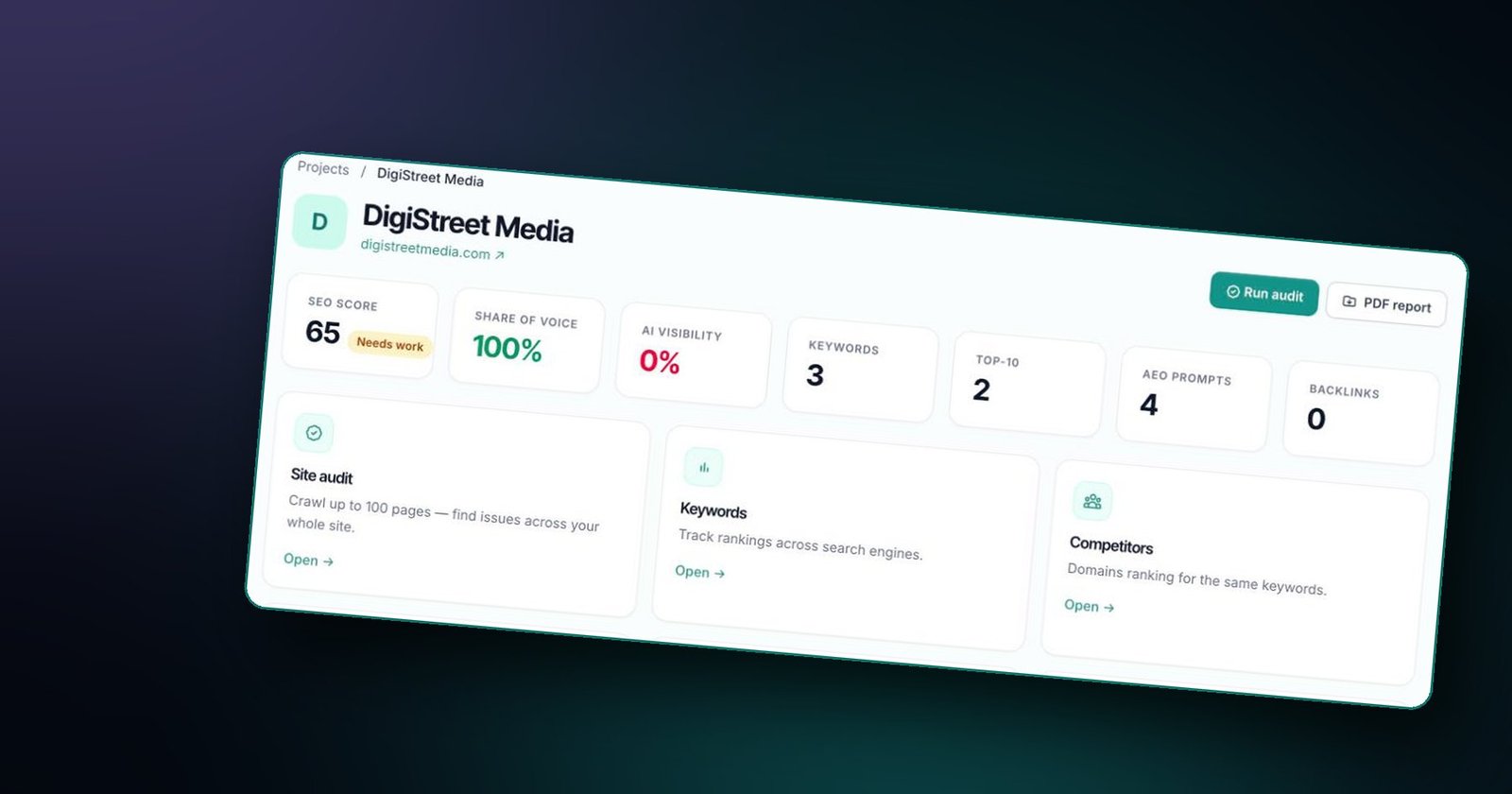
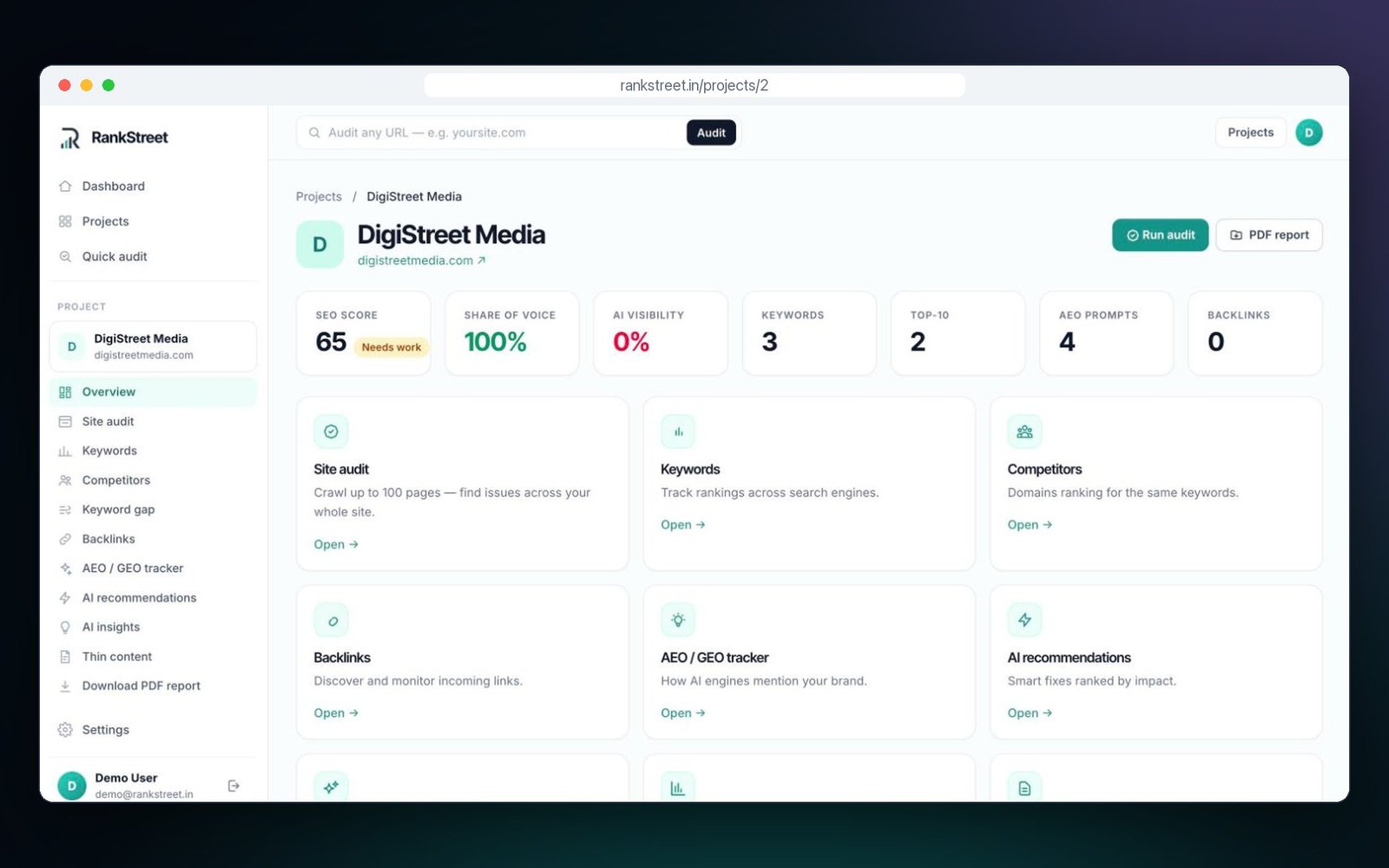
As of this rewrite, the RankStreet project for digistreetmedia.com shows an SEO score of 65, labelled "Needs work". That is one point above the published 64, and we are deliberately not dressing it up. A 65 is a site with good bones and clear gaps.
Rankings and share of voice
The project tracks three keywords. Two of them currently rank in the top ten, and RankStreet reports 100% share of voice for the set. Recent rank alerts recorded:
- "B2b Digital Marketing Agency in India" reaching #1.
- "digital marketing agency delhi" at #7.
Three keywords is a small set, and we say so plainly. It is a focused list of the commercial terms that matter most to the business, not a vanity list of hundreds of long-tail phrases. The "digital marketing agency delhi" position is the one we care about most, and #7 tells us the page is relevant but not yet the strongest result for that query.
What the audit says is strong
The technical layer is in good shape. The audit passes HTTPS, canonical tags, robots.txt and the XML sitemap, and detects structured data across a healthy range of types: FAQPage, Organization, WebSite, BreadcrumbList, Service and Product. For an agency site, that is a better schema footprint than most of the competitors we checked.
What the audit says is weak
Two areas hold the score back:
- Thin main content on the homepage. By the audit's measure, the main content area of the homepage is thin. Plenty of the page is navigation, logos and visual sections, but the actual body copy that explains what we do, for whom and how is short. This matters more in 2026 than it did a few years ago, because AI Overviews and assistants need substantive text to quote. A page made mostly of design has little to cite.
- Mobile and performance. These remain the weakest sections. The hero fix helped, but LCP is still above the 2.5 second threshold, and third-party scripts weigh on interactivity.
What we are fixing next
This is the same prioritised list we would hand a client with this profile:
- Expand the homepage body copy. Add a direct-answer paragraph in the first 100 words ("Digistreet Media is a digital marketing agency in Delhi that..."), followed by substantive sections on services, industries and process. The aim is depth, not word count for its own sake.
- Lead every service page with an answer, not a story. Our service pages open with brand narrative. AI Overviews and assistants favour pages where the first paragraph states plainly what the service is, who it is for and how it works.
- Cut third-party JavaScript. A chat widget, a heatmap tool, Google Analytics and Google Tag Manager are each small, but together they cost interactivity on mid-range Android phones. We will defer or remove what we can.
- Add bylines to case studies. Our case-study pages show client logos but no author. A named author with a short bio and a link to a real profile is a cheap, durable trust signal.
- Keep publishing first-hand evidence. Case studies like this one are exactly the kind of experience-based content that both Google's quality guidelines and AI answer engines reward.
Lessons that transfer to your site
- Read the section breakdown, not the headline score. Our 55 was really "fine technically, weak on performance". That told us where to start.
- Brand H1s are expensive. If your H1 is a tagline, you are asking search engines to guess what the page is about. Put the keyword in the H1 and the tagline underneath.
- Structured data is necessary but not sufficient. We have six schema types and still score 65, because thin content and slow mobile pages are not things markup can fix.
- Track a few keywords well. Three well-chosen commercial keywords with rank alerts tell us more than a dashboard of 300 phrases nobody searches.
If you want the broader framework behind these fixes, read what a free website audit should check and our guide to optimising for Google AI Overviews.
Run the same audit on your site
Nothing in this case study needed special access. Run the free 60+ point RankStreet audit on your own homepage and you will get the same Content, Technical, Performance and Mobile breakdown, with a prioritised fix list. Save the site as a project to add rank tracking, the AEO/GEO tracker and PDF reports you can share with your team. And if you would rather have the team behind this case study run the playbook for you, talk to Digistreet Media.
Frequently asked questions
What did the digistreetmedia.com SEO audit case study change first?
The first fix was adding FAQPage structured data to the homepage and six service pages, using real questions from sales calls. It produced the biggest section-level change in the audit, moving AEO friendliness from 42 to 78.
Why is a 65 SEO score still labelled "Needs work"?
RankStreet treats scores below 70 as needing work because at least one section has a material gap. For digistreetmedia.com, those gaps are thin homepage body copy and mobile performance, even though the technical layer is strong.
Can a site rank #1 with an SEO score of 65?
Yes. The audit score measures how well a page follows good practice, not its ranking. digistreetmedia.com reached #1 for "B2b Digital Marketing Agency in India" with a 65. A higher score improves the odds across more queries, but it is not a ranking guarantee.
Does adding Review schema to testimonials give you star ratings?
Not for reviews a business publishes about itself. Google considers these self-serving and does not show stars for them. The markup still makes testimonials machine-readable, which supports trust signals.
How long does a fix list like this take to ship?
The five fixes here are small: FAQ copy and JSON-LD, one image swap, one H1 rewrite and two schema blocks. A small team can ship them in a working week. The harder items, such as expanding content and cutting scripts, take longer.
Ready to put this into practice?
Run a free 60-point audit on any URL and get a prioritised fix list in under a minute.
About the publisher
Built by Digistreet Media
RankStreet is built and operated by Digistreet Media — a digital marketing and SEO agency with 13+ years across Finance, FMCG, Real Estate, B2B, Automobiles, Fashion, SaaS, Healthcare and Commerce. Prefer a senior team to run the audit and the fixes for you? Talk to Digistreet.