 RankStreet

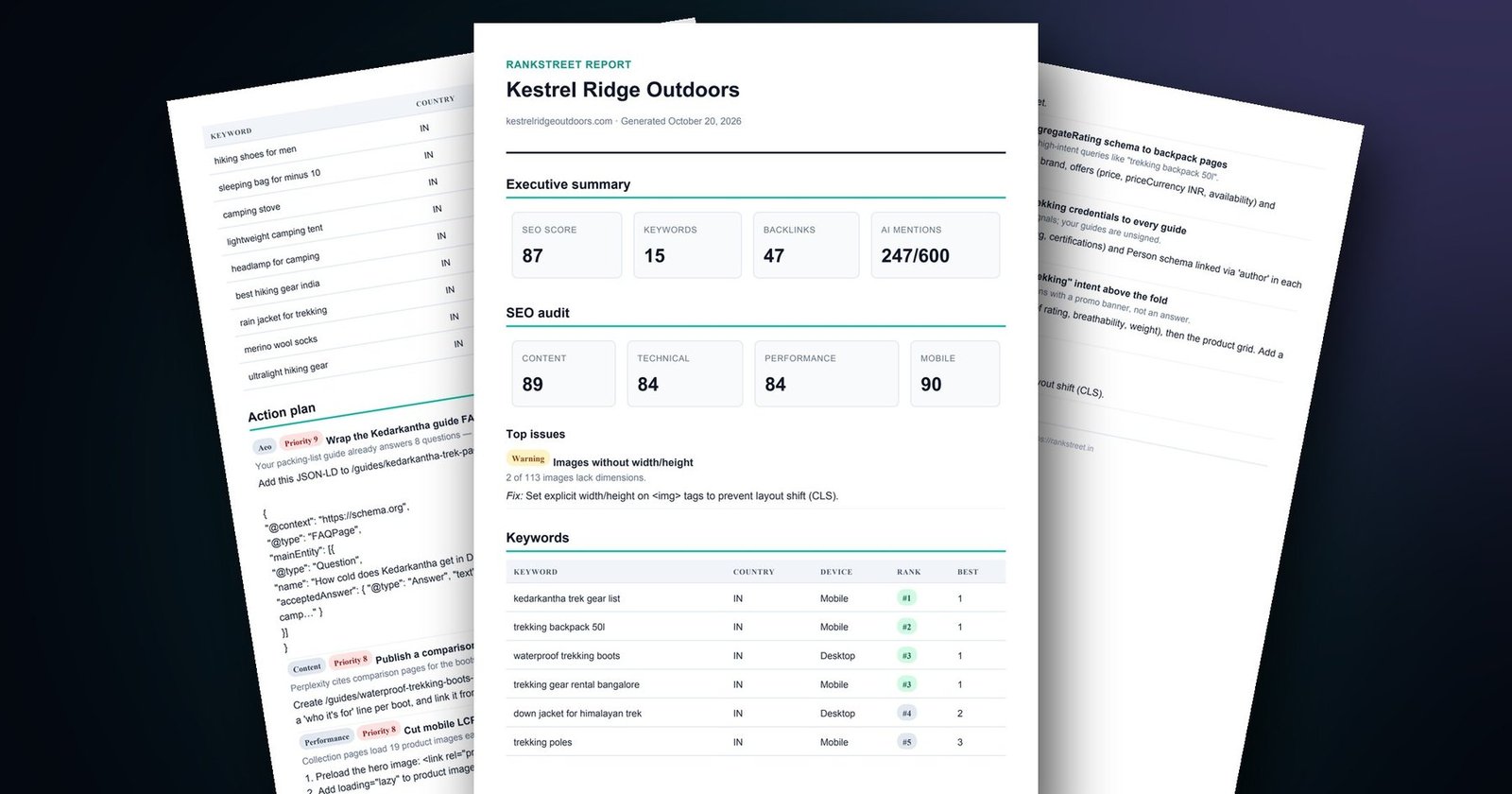
Most SEO reports fail for one of two reasons. Either they drown leadership in metrics nobody asked for, or they report a single traffic number that rises and falls for reasons the team cannot explain. Neither builds confidence. What works is a short chain of evidence from the work shipped, to visibility gained, to business outcomes.
Why it is harder to prove SEO ROI in 2026
Three shifts complicate the old "sessions up, so SEO works" story:
- Zero-click answers. AI Overviews, featured snippets and knowledge panels answer many informational queries on the results page. You can be highly visible and receive fewer clicks.
- Answer engines. Buyers shortlist suppliers in ChatGPT, Claude, Perplexity and Gemini. A mention there influences a decision, but the visit may arrive later as direct or branded search traffic.
- Longer, messier journeys. B2B buyers in particular touch a brand many times before converting, and last-click attribution credits SEO for little of it.
Through 2027 we expect these trends to strengthen, especially as AI agents start doing comparison research on buyers' behalf. The answer is not to give up on ROI. It is to measure at three levels.
The three layers of SEO evidence
| Layer | Question it answers | Metrics |
|---|---|---|
| 1. Work | What did we ship and did it improve the site? | Audit scores by section, fixes shipped, pages improved |
| 2. Visibility | Are we more visible where buyers look? | Rankings, share of voice, impressions, AI mention rate |
| 3. Outcomes | Is visibility turning into business? | Organic and AI-referred leads, conversions, revenue, branded search growth |
Each layer supports the next. If outcomes dip, the visibility layer tells you whether it is an SEO problem or a market problem. If visibility stalls, the work layer tells you whether the team shipped what it planned.
Layer 1: prove the work with audit scores
Leadership rarely doubts that the team is busy. They want to know whether the work is improving anything. A section-by-section audit score, re-run after each batch of fixes, is the clearest proof.
Our own site is a useful example. In our digistreetmedia.com case study, five specific fixes moved the RankStreet score from 55 to 64, with performance rising 22 points from one image change. That is a sentence a CMO understands: "We shipped five fixes; the site moved nine points; the biggest gain came from the homepage hero."
Practical setup:
- Add your ten most important pages to a RankStreet project.
- Record the baseline section scores: content, technical, performance and mobile.
- Log every fix with a date, so you can line up score changes with the work behind them.
Layer 2: prove visibility, including AI visibility
Rankings and share of voice
Track a focused list of commercial keywords, not hundreds of vanity terms. Share of voice, the proportion of your tracked keywords on page one, gives leadership a single trend line. For example, the RankStreet project for digistreetmedia.com tracks three commercial keywords; two rank in the top three and all three are on page one, which reports as 100% share of voice. Rank alerts flagged when "B2b Digital Marketing Agency in India" reached #1. A small, well-chosen list makes those signals meaningful.
Impressions and click-through rate
In Search Console, rising impressions with falling click-through rate on informational pages often indicates that AI Overviews are answering the query. Report it honestly: visibility is growing even where clicks are not.
AI mention rate
Build a list of 15 to 30 prompts that mirror real buying questions and track them across assistants. Example prompts for a B2B logistics software company:
- "What are the best fleet management software options for Indian logistics companies?"
- "Compare fleet tracking tools that integrate with Tally."
- "Which fleet management platforms offer fuel monitoring for trucks in India?"
RankStreet's AEO/GEO tracker re-runs saved prompts across ChatGPT, Claude, Perplexity and Gemini and records whether your brand is mentioned. Report mention rate as a percentage of prompts, and the trend over time.
Layer 3: connect visibility to outcomes
This is where most reports fall short. The minimum setup:
- Key events in GA4 for every meaningful action: form submissions, demo bookings, calls, sign-ups, purchases.
- Channel segmentation for organic search and for AI referrals. Create a segment for sessions from assistant domains such as
chatgpt.com,perplexity.ai,gemini.google.comandclaude.ai. - CRM source tracking, so a lead from organic search is still attributed when it closes three months later.
- A "how did you hear about us" field. Self-reported attribution increasingly surfaces answers such as "ChatGPT recommended you", which no analytics tool captures.
- Branded search trend. Growth in branded queries is often the downstream effect of visibility in AI answers and zero-click results.
A worked SEO ROI calculation
The formula is simple:
SEO ROI = (Revenue attributable to SEO - Cost of SEO) / Cost of SEOHere is an illustrative example with hypothetical numbers for a B2B services firm over six months:
| Input | Value (hypothetical) |
|---|---|
| Organic and AI-referred qualified leads | 60 |
| Lead-to-customer rate | 10% |
| New customers | 6 |
| Average first-year contract value | Rs 4,00,000 |
| Attributable revenue | Rs 24,00,000 |
| SEO cost (team, tools, content) | Rs 9,00,000 |
| ROI | (24,00,000 - 9,00,000) / 9,00,000 = 1.67, or 167% |
Two honest caveats belong in every ROI slide. First, the attribution method: say whether you used last-click, data-driven attribution or self-reported sources. Second, the time horizon: SEO results compound, so a six-month window usually understates lifetime value. Being upfront about both makes the number more credible, not less.
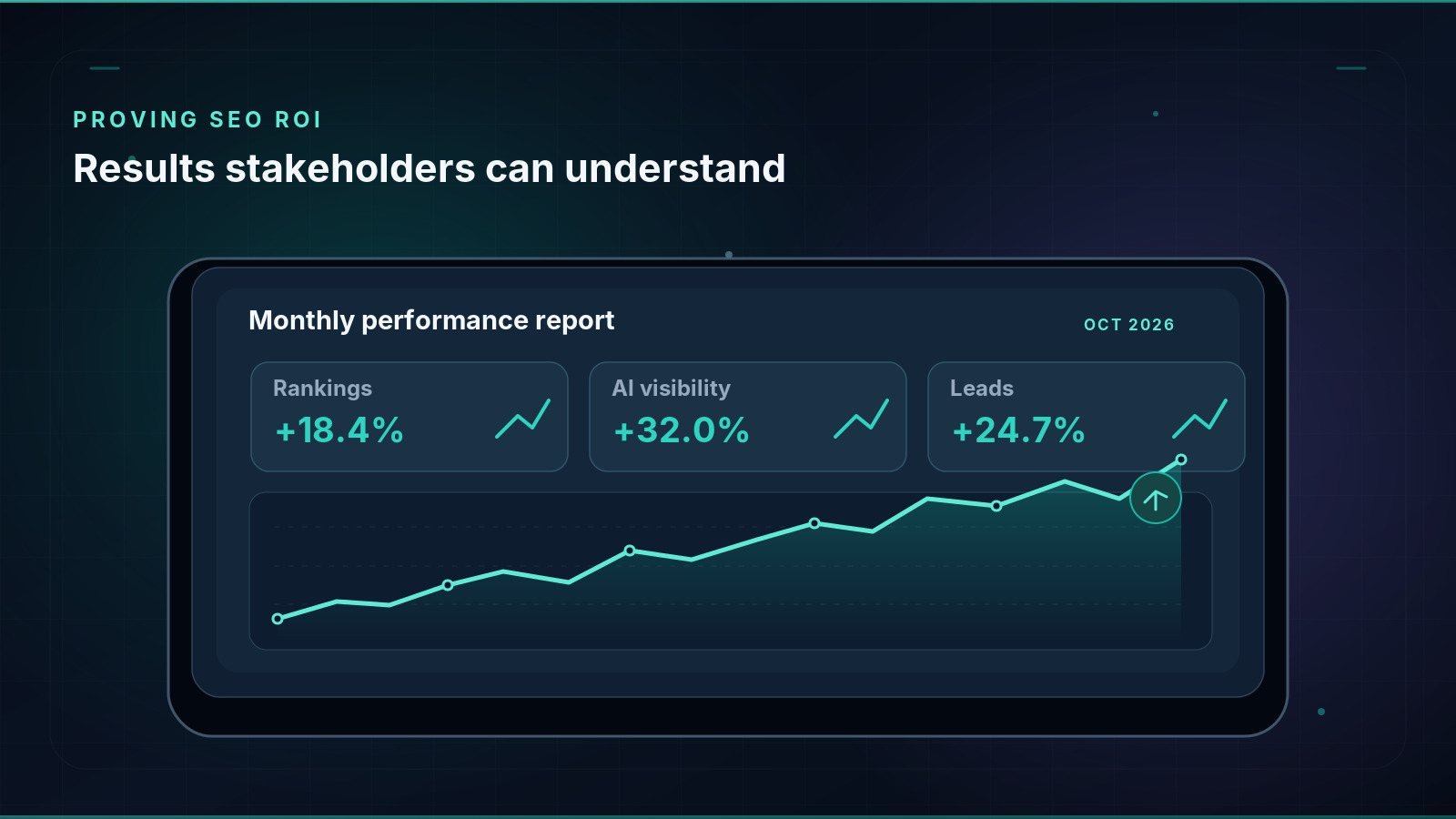
A monthly SEO report leadership will read
Keep it to one page, plus an appendix. The structure we use:
- Headline (two sentences). "Organic leads up from X to Y. Two priority keywords moved into the top three."
- Outcomes. Leads, conversions and revenue from organic and AI referrals, against target.
- Visibility. Share of voice, top keyword movements and AI mention rate.
- Work shipped. The fixes made and the audit score change they produced.
- Next month. The three priorities and what each is expected to move.
RankStreet's PDF reports cover the audit and visibility sections in a format you can attach directly, which saves rebuilding slides each month.
Reporting mistakes that undermine trust
- Reporting total organic traffic without context. A spike from one viral blog post can hide a decline on money pages. Segment by page type.
- Celebrating rankings for keywords nobody buys from. Leadership quickly notices when "position 1" never turns into leads. Track commercial keywords first.
- Changing the keyword list every month. Trends need a stable set. Add keywords deliberately and annotate when you do.
- Hiding bad months. Explaining a dip, such as an algorithm update, a seasonal pattern or a site release that broke something, builds more credibility than a report that only ever goes up.
- Treating AI visibility as unmeasurable. It is imperfect, but a stable set of tracked prompts gives a defensible trend line.
Tailor the same evidence to each audience
The underlying data stays the same; the emphasis changes. A founder or CEO wants the outcome line and one sentence on why. A CMO wants visibility trends against competitors and the plan for next quarter. A CFO wants cost, attributable revenue and the attribution method. A product or engineering lead wants the specific technical fixes and their measured effect, so they can see why a ticket mattered. Build one source report, then cut a short version for each audience instead of producing four different reports from scratch.
How different roles use this playbook
- Performance marketers: audit every paid landing page before launch. A slow, unclear page wastes ad spend as surely as a poor bid strategy.
- Content leads: use the audit's targeted-keyword and AEO friendliness checks as a pre-publish gate, and share the action plan with writers as the brief.
- In-house SEO managers: use project-level tracking to triage which page to fix next and to show week-by-week movement.
- Agencies and consultants: run an audit before the first pitch meeting and re-run it at every quarterly review, so the conversation is anchored in measured change.
A weekly workflow that takes about an hour
- Monday: review rank alerts and AI mention changes; re-audit any page that moved unexpectedly.
- Tuesday to Thursday: ship the top fixes from the action plan on your weakest priority pages. Use RankStreet's AI fix suggestions as a first draft and edit them into your brand voice.
- Friday: re-audit the pages you changed and log the score movement against the fix.
The goal is not a perfect score. It is a visible trend line that links work to visibility to outcomes. For broader context on what to measure as search changes, see SEO vs AEO vs GEO and SEO trends for 2027.
Start with a free RankStreet audit to set your baseline. If you need a team to run the work and the reporting, talk to Digistreet Media.
Frequently asked questions
How do you prove SEO ROI?
Measure three layers: the work shipped and its effect on audit scores, visibility gains in rankings, share of voice and AI mentions, and business outcomes such as leads and revenue from organic and AI-referred traffic. Then calculate ROI as attributable revenue minus cost, divided by cost.
How do I measure SEO success when AI Overviews reduce clicks?
Report impressions, share of voice and AI mention rate alongside traffic. Rising impressions with falling click-through rate often means you are visible in answers even when users do not click.
Can I track traffic from ChatGPT and other assistants?
Partly. Visits from assistant domains such as chatgpt.com and perplexity.ai appear as referrals in analytics, and ChatGPT often adds a utm_source parameter. Some influence is invisible, so add a self-reported source field to forms.
What is share of voice in SEO?
In rank tracking, share of voice usually means the proportion of your tracked keywords that rank on page one, sometimes weighted by search volume. It gives a single visibility trend that is easy to report.
How long before SEO shows a positive ROI?
It varies with competition and starting point. Early visibility gains often appear within three to six months, while revenue-level ROI usually takes longer because SEO results compound and sales cycles add delay.
Ready to put this into practice?
Run a free 60-point audit on any URL and get a prioritised fix list in under a minute.
About the publisher
Built by Digistreet Media
RankStreet is built and operated by Digistreet Media — a digital marketing and SEO agency with 13+ years across Finance, FMCG, Real Estate, B2B, Automobiles, Fashion, SaaS, Healthcare and Commerce. Prefer a senior team to run the audit and the fixes for you? Talk to Digistreet.